1 · Self-teacher
Frozen copy of the same VLM
Sees the camera image with the demonstrated (GT) trajectory overlaid, and writes the goal and a reasoning trace.
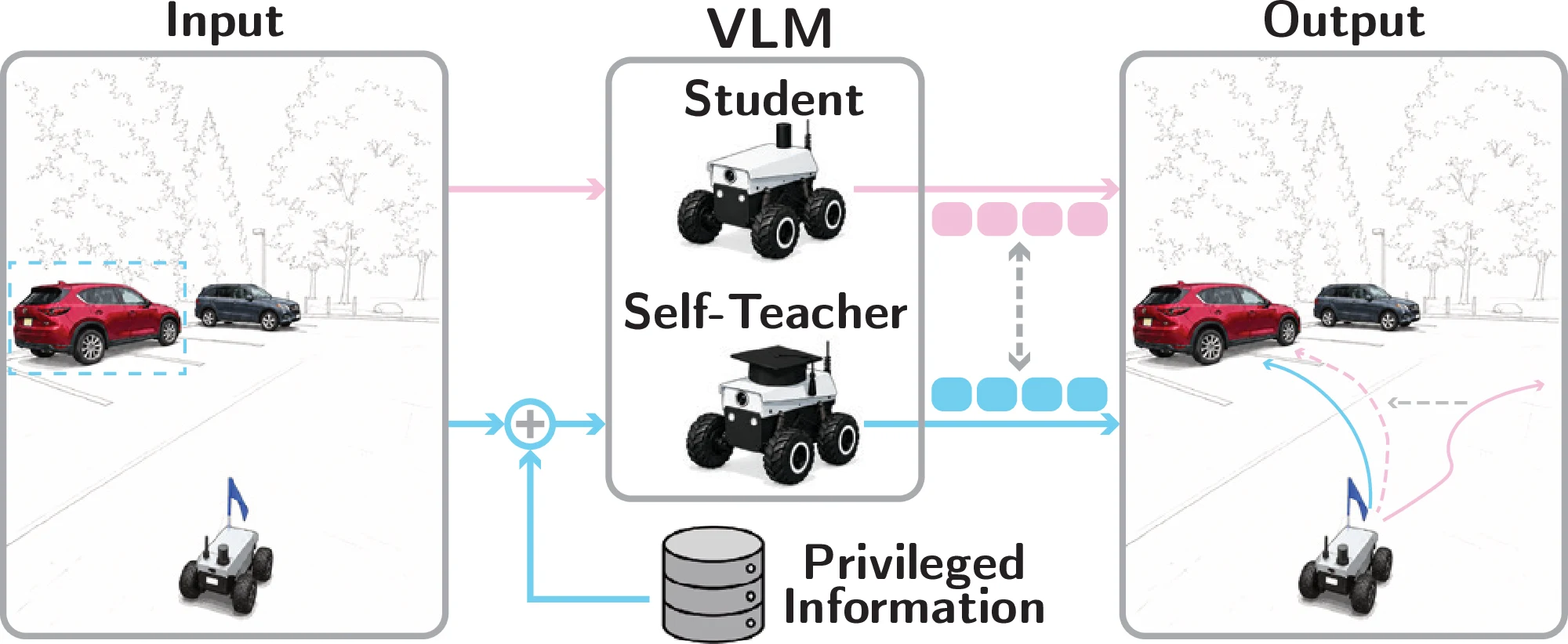
TL;DR: A VLM teaches itself to navigate from language by explaining recorded demonstrations — no human goal or reasoning labels needed.
Overview
How it works
One open-source VLM plays both roles. Training uses only recorded trajectories — no human-written goals or reasoning traces.
Frozen copy of the same VLM
Sees the camera image with the demonstrated (GT) trajectory overlaid, and writes the goal and a reasoning trace.
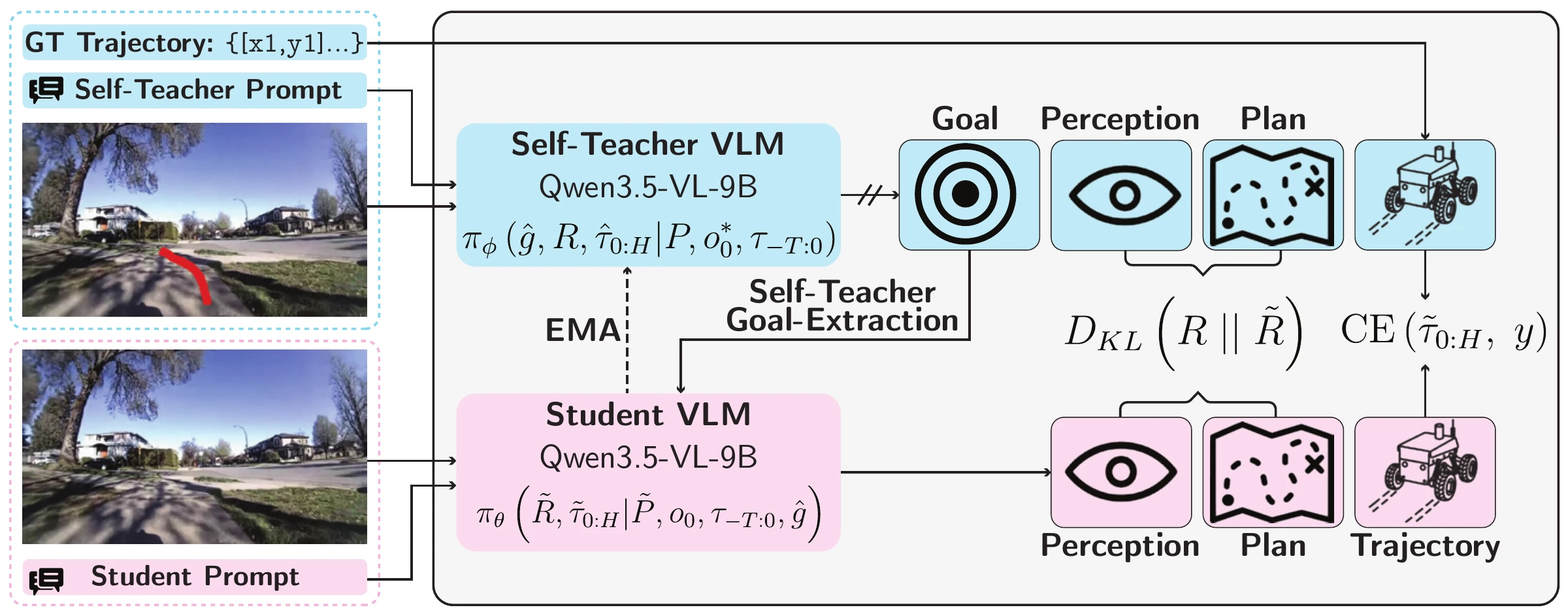
Same VLM, learns from the teacher
Sees only the camera image and the goal, and learns to produce the same reasoning and trajectory.
Student only, no teacher
The student alone steers the robot from a camera image and a language command, with a short trace for each action.
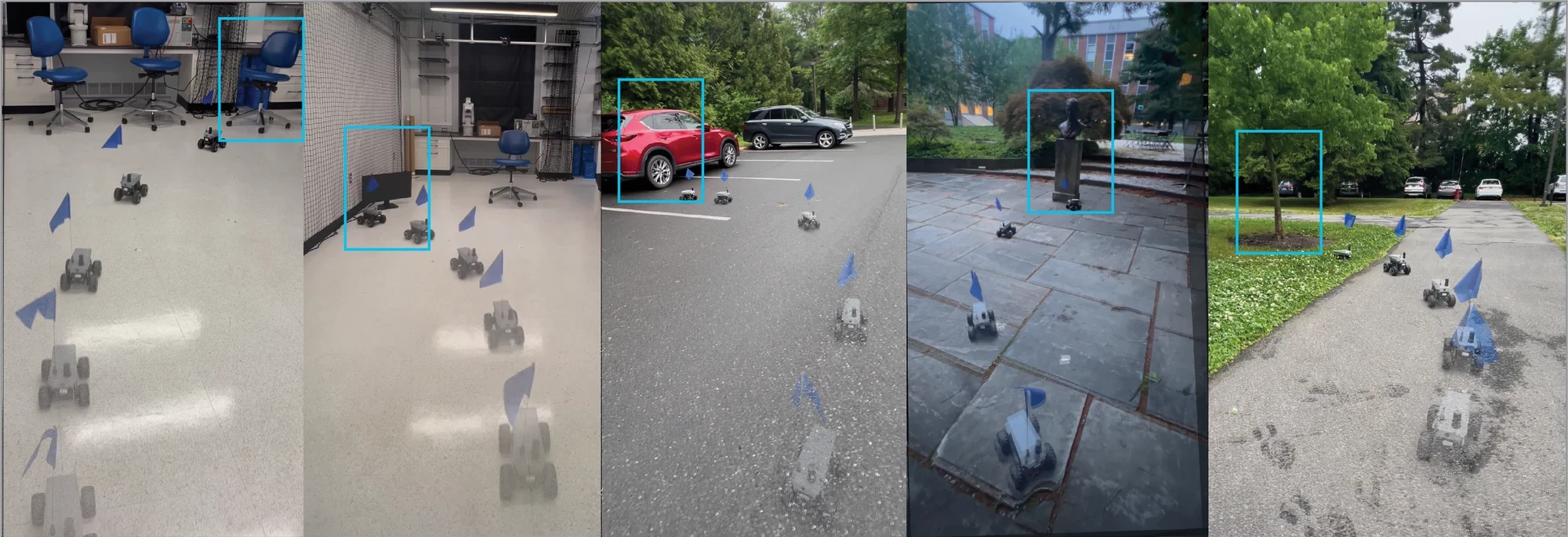
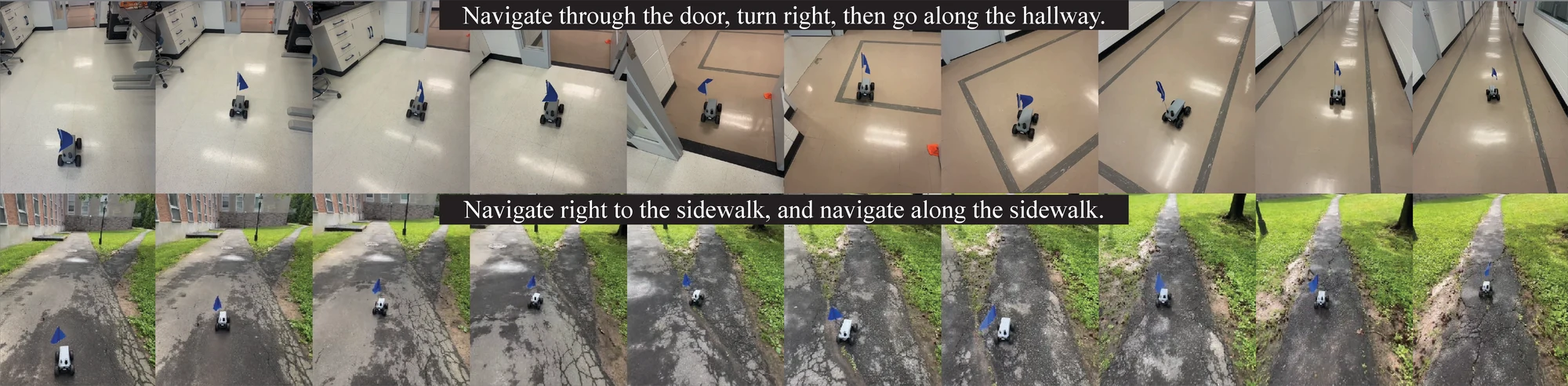
Zero-shot on a FrodoBot rover
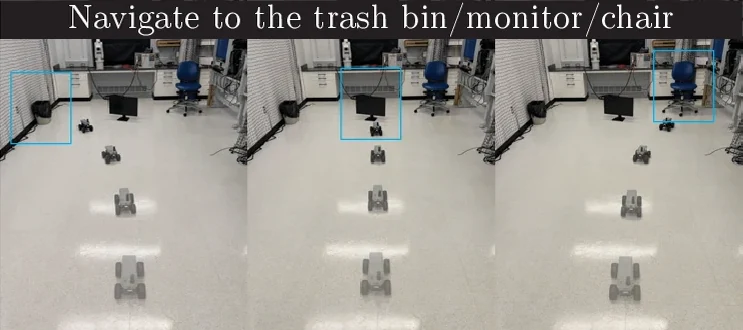
Indoor and outdoor clips run ASD side by side with the best baseline; the prompt and success rate are shown in each clip. Click a clip to pause it.
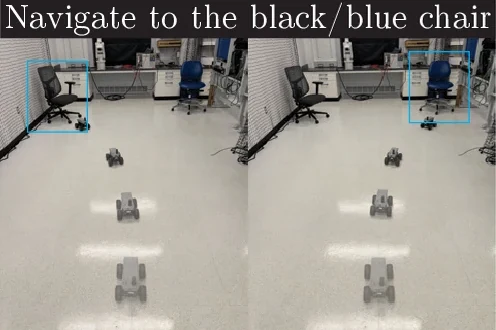
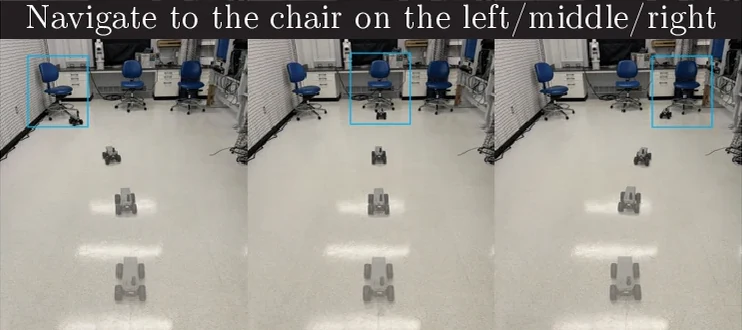
Interactive · pick a capability
Same scene, different prompt — pick one to see the rollout.
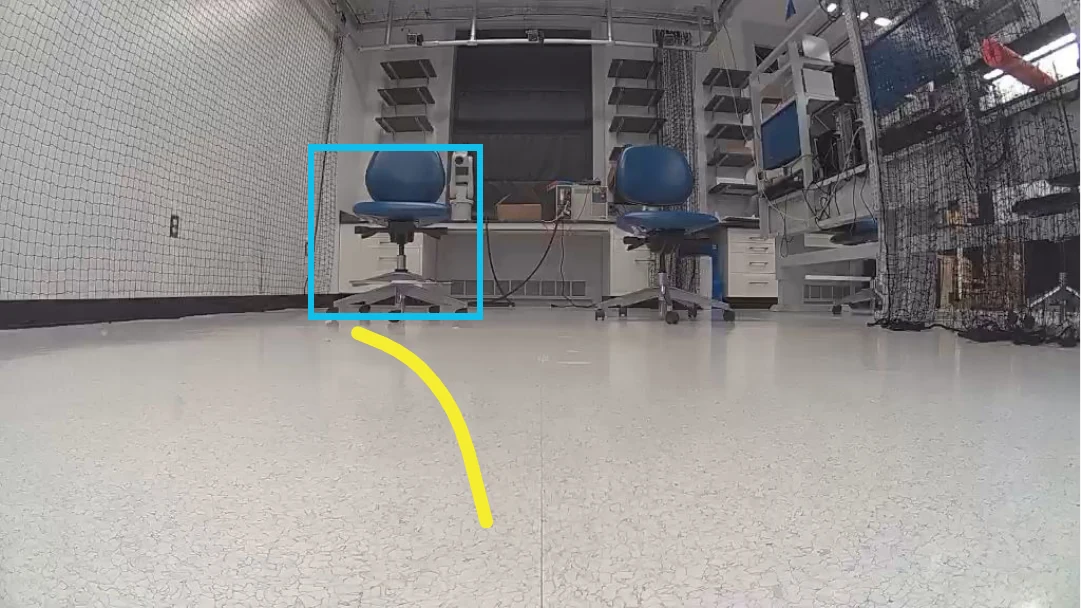
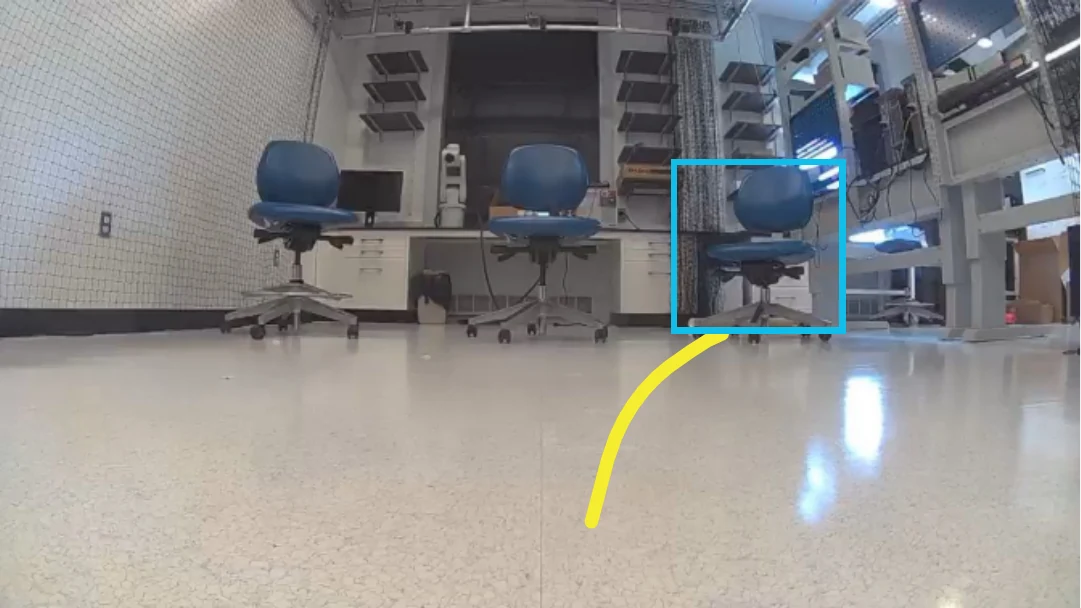
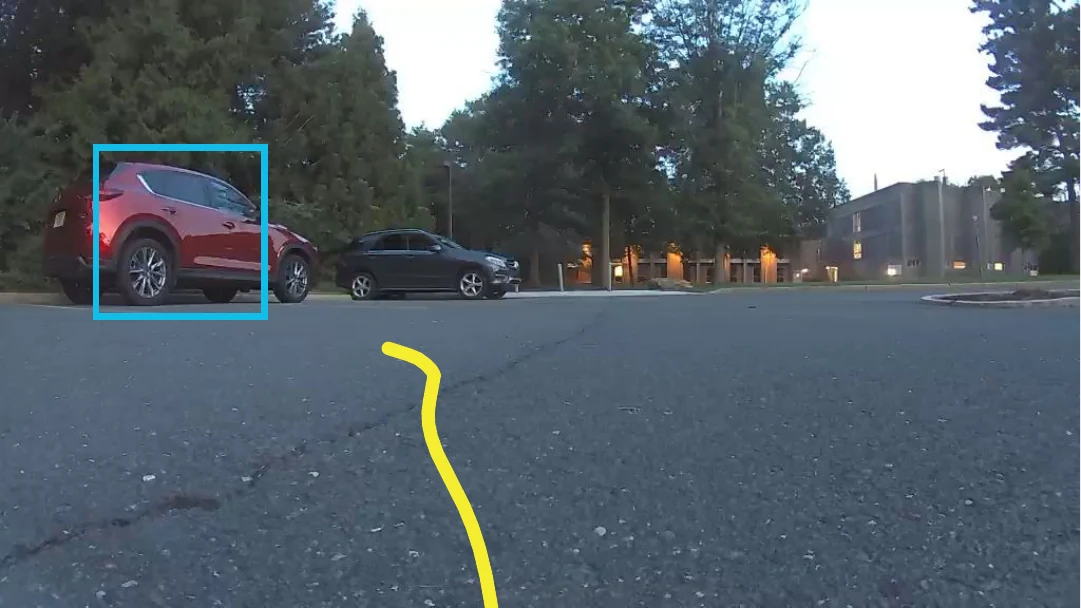
Explainable actions
Each action comes with a short trace covering the task, perception, and planning.
Task: Navigate to the chair on the left
Perception: The ground surface is a smooth, light-colored floor with a speckled texture. Ahead of the robot, there is a large expanse of open space leading to a white wall on the far side. Along the wall, there is a long workbench with a dark surface, and two blue office chairs with metal bases are positioned in front of it.
Planning: Turn left. This movement is right because the floor surface remains level and open across the entire area ahead of the robot, allowing the vehicle to pivot freely. The path leads directly toward the open region in front of the workbench and the blue office chairs, which are situated along the trajectory.
Task: Navigate to the chair on the right
Perception: The ground surface is a smooth, light-colored floor with a speckled texture. Ahead of the robot, there is a large expanse of open space leading to a row of white cabinets and shelving units mounted on the wall. Three blue office chairs with metal bases are positioned in front of the cabinets.
Planning: Turn right. This motion is sensible because the floor surface remains level and open across the entire area ahead of the robot, allowing the vehicle to pivot freely. The path leads directly toward the blue office chair that is situated in front of the white cabinets, ensuring the robot stays on the open floor and moves toward that specific object.
Task: Navigate to the red car
Perception: The ground surface is dark gray asphalt. A large building with a flat facade and lit windows is visible in the distance. Dense rows of trees line the area behind the paved surface. There is a wide expanse of open pavement stretching out into the foreground, with no obstacles breaking the view toward the building and the parked vehicles.
Planning: Turn left. This motion is right because the asphalt surface remains level and open, allowing the vehicle to pivot freely without encountering any obstacles. The path leads directly toward the red car, which is positioned on the pavement in the region where the vehicle must turn to align with the open space ahead.
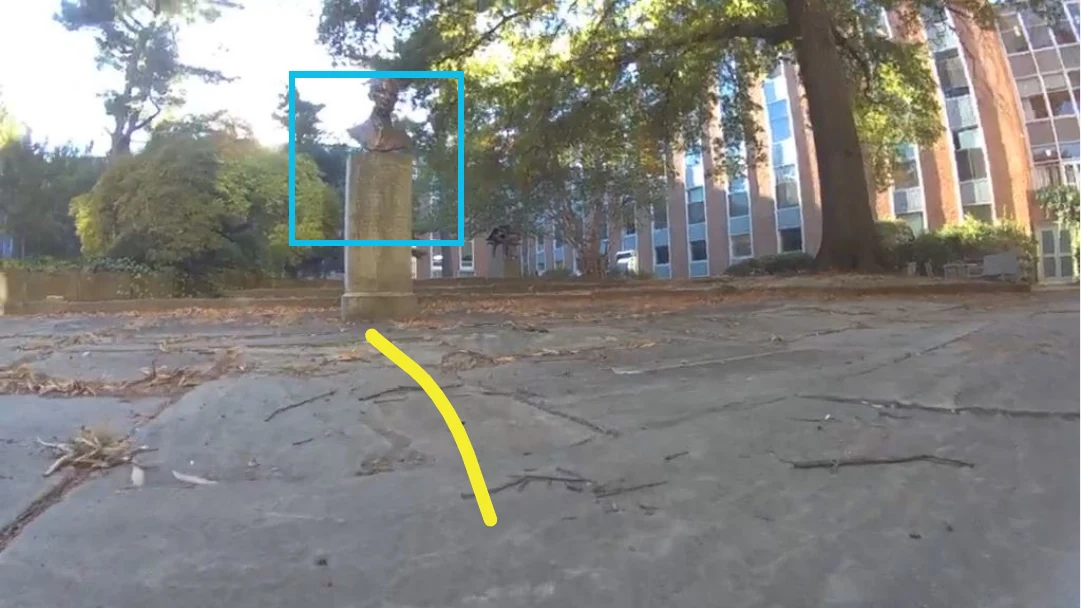
Task: Navigate to the statue
Perception: The ground surface consists of large, flat concrete slabs with visible seams running across the terrain. Ahead of the robot, the open space is extensive, leading toward a large brick building with multiple stories and a dense cluster of trees with full canopies. A stone monument stands clearly visible in the distance, situated on the same level paved surface.
Planning: Turn left. This movement is right because the concrete pavement remains level and continuous in the direction the operator has chosen, allowing the robot to proceed unimpeded toward the stone monument. The open expanse of the paved area extends fully toward the monument, ensuring the path stays clear of the large trees and the brick building that define the far side of the scene.
Numbers
| Directions | Objects | Multi-stage | ||||||||
|---|---|---|---|---|---|---|---|---|---|---|
| Method | Straight door− | Left chair+ | Right chair* | Blue chair− | Trash bin− | Chair+ | Monitor* | Doorway+ | Hallway* | Avg. |
| OmniVLA | 0.8 | 0.9 | 0.2 | 0.7 | 1.0 | 0.4 | 0.2 | 0.7 | 0.0 | 0.54 |
| NaVILA | 0.3 | 0.2 | 0.1 | 0.4 | 0.1 | 0.3 | 0.2 | 0.3 | 0.5 | 0.27 |
| Qwen2.5-VL-ASD | 0.9 | 1.0 | 0.8 | 1.0 | 0.9 | 0.9 | 0.7 | 0.8 | 0.6 | 0.84 |
| Qwen3.5-VL-ASD | 1.0 | 1.0 | 0.9 | 1.0 | 1.0 | 1.0 | 0.9 | 0.9 | 0.8 | 0.94 |
| Method | Sidewalk | Statue | Tree | Car | Avg. |
|---|---|---|---|---|---|
| OmniVLA | 1.0 | 0.6 | 1.0 | 1.0 | 0.90 |
| NaVILA | 0.9 | 0.1 | 0.0 | 0.3 | 0.33 |
| Qwen2.5-VL-ASD | 1.0 | 0.8 | 1.0 | 1.0 | 0.95 |
| Qwen3.5-VL-ASD | 1.0 | 0.9 | 1.0 | 1.0 | 0.98 |
| Method | Success ↑ | Completion time (s) ↓ |
|---|---|---|
| OmniVLA | 0.9 | 25.3 |
| NaVILA | 0.2 | 28.9 |
| Qwen2.5-VL (vanilla) | 0.0 | — |
| Claude Opus 4.7 | 0.7 | 846.1 |
| Qwen2.5-VL-ASD | 1.0 | 15.3 |
| Method | Right chair | Chair | Monitor | Hallway | Car | Avg. |
|---|---|---|---|---|---|---|
| ASD, goal-only supervision | 0.4 | 0.2 | 0.2 | 0.1 | 0.4 | 0.26 |
| ASD, reasoning off at inference | 0.1 | 0.2 | 0.2 | 0.0 | 0.2 | 0.14 |
| Claude Opus 5 labels + SFT | 0.3 | 0.5 | 0.3 | 0.3 | 0.4 | 0.36 |
| Qwen2.5-VL labels + SFT | 0.4 | 0.3 | 0.3 | 0.0 | 0.1 | 0.22 |
| NaVILA (RECON + FrodoBots-2K SFT) | 0.0 | 0.1 | 0.2 | 0.3 | 0.2 | 0.16 |
| Qwen2.5-VL-ASD | 0.8 | 0.9 | 0.7 | 0.6 | 1.0 | 0.80 |
| Qwen3.5-VL-ASD | 0.9 | 1.0 | 0.9 | 0.8 | 1.0 | 0.92 |
| RECON | FrodoBots-2K | |||||||
|---|---|---|---|---|---|---|---|---|
| Method | ADE | ATE | MAE | MSE | ADE | ATE | MAE | MSE |
| Gaussian Policy | 0.226 | 0.321 | 0.144 | 0.059 | 0.034 | 0.046 | 0.019 | 0.002 |
| Gaussian Mixture | 0.260 | 0.364 | 0.166 | 0.084 | 0.036 | 0.050 | 0.020 | 0.002 |
| Diffusion Policy | 0.180 | 0.238 | 0.108 | 0.045 | 0.034 | 0.045 | 0.020 | 0.003 |
| Qwen2.5-VL + SFT | 0.192 | 0.247 | 0.115 | 0.042 | 0.064 | 0.061 | 0.027 | 0.007 |
| Alpamayo-1 + SFT | 0.303 | 0.362 | 0.188 | 0.091 | 0.093 | 0.106 | 0.055 | 0.041 |
| OpenVLA + SFT | 0.341 | 0.417 | 0.208 | 0.114 | 0.246 | 0.269 | 0.138 | 0.072 |
| Qwen2.5-VL-ASD | 0.174 | 0.227 | 0.104 | 0.037 | 0.031 | 0.042 | 0.017 | 0.004 |
Cite
@inproceedings{feng2026asd,
title = {Training Generalist Navigation Policies via Action Self-Distillation},
author = {Feng, Bowen and Wang, Keqin and Yang, Yulong and Joshi, Amogh
and Allen-Blanchette, Christine and Shah, Dhruv and Heide, Felix},
booktitle = {Conference on Robot Learning (CoRL)},
year = {2026},
}